



Plastic, Metal, or Carbon: Which Materials Truly Last for Years

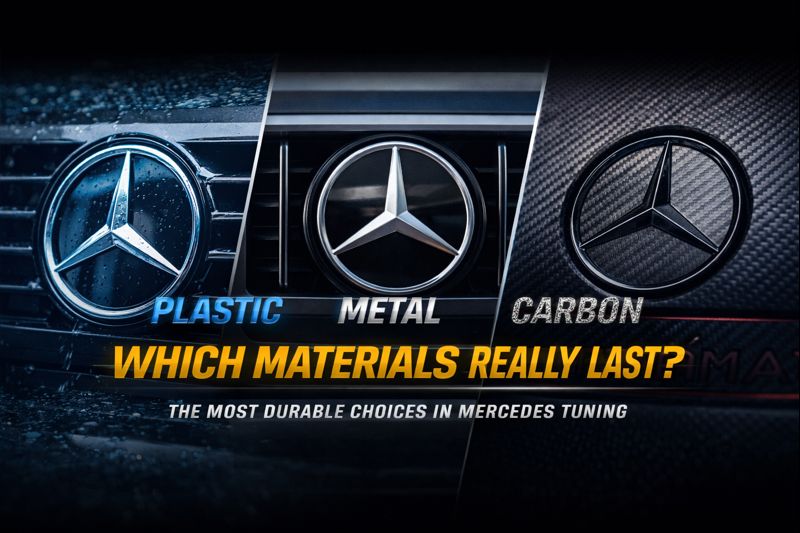
In the world of premium car tuning – especially when it comes to Mercedes-Benz – the key question has changed.
It’s no longer just “How does it look?”
Today, owners ask: “How long will it look this good?”
The market is flooded with badges, emblems, trim parts, and decorative upgrades. Many look impressive at first glance – but only a few materials can truly survive:
- years of sun exposure
- temperature extremes
- moisture and road chemicals
- daily use
Let’s break down which materials actually last, and which ones only imitate quality.
Why Material Matters More Than Design
Even the most beautiful design loses its value if:
- it fades after one summer
- peels after one winter
- cracks, rusts, or oxidizes within two years
In the premium segment, material is the foundation. Design only works if the base is solid.
Plastic: Not the Enemy – If It’s the Right One
Where automotive plastic comes from
Automotive plastic is not household plastic.
OEM-grade manufacturers use:
- reinforced ABS
- polycarbonate
- composite thermoplastics
These materials are used by Mercedes in:
- front grilles
- trim pieces
- components integrated with sensors and radar systems
When plastic lasts for years
Plastic performs well when:
- used in the correct application
- not exposed to structural stress
- made from automotive-grade material
- protected with UV-resistant coatings
Best example:
LED emblems and radar-compatible grille badges – metal simply cannot be used here.
When plastic fails
Problems appear when:
- cheap ABS is used
- there is no UV protection
- paint is applied without proper primer
The result:
- yellowing
- fading
- cracking in cold temperatures
Metal: The Classic Choice That Stands the Test of Time
Which metals actually last
High-quality custom parts typically use:
- aluminum alloys
- stainless steel
- brass
- zinc-based alloys
These metals resist:
- moisture
- temperature changes
- mechanical wear
Why metal is ideal for emblems
Metal emblems:
- retain their shape
- don’t fade
- have weight (a subconscious sign of quality)
- often last 5–10 years or more
The most durable finishes include:
- anodized coatings
- powder coating
- sealed paint with clear protection
Common mistakes with metal
Even metal can fail if:
- anti-corrosion treatment is missing
- low-grade alloy is used
- no protective layer is applied
This leads to oxidation and surface damage over time.
Carbon Fiber: No Longer Just for Racing
Where carbon fiber comes from
Carbon fiber was first used in:
- aviation
- aerospace
- motorsport
Only later did it become part of luxury automotive design.
Real carbon vs imitation
Real carbon fiber:
- is made from woven carbon strands
- impregnated with resin
- sealed with a protective clear coat
Imitation carbon:
- printed patterns
- vinyl wraps
- textured plastic
The difference becomes obvious after one year of use.
Why real carbon lasts
High-quality carbon fiber:
- doesn’t fade
- resists moisture
- tolerates heat and cold
- maintains structural integrity
The most durable types include:
- forged carbon
- carbon with deep clear resin layers
Hybrid Solutions: The Best of All Worlds
Modern premium tuning favors combined materials:
- metal base + carbon lettering
- plastic structure + metal logo
- carbon surface + protective clear coat
These combinations deliver:
- structural strength
- long-term durability
- visual depth and luxury
Real-World Examples
🔹 Metal tail emblems on the G-Class
Often remain unchanged after 7–10 years.
🔹 Carbon interior trim pieces
Maintain their look even with daily use.
🔹 Low-quality plastic parts
Often require replacement after 1–2 seasons.
Which Material Should You Choose?
Maximum longevity:
→ Metal + carbon
Electronic compatibility (radar / LED):
→ High-grade automotive plastic
Balanced price and durability:
→ Hybrid solutions
Conclusion
Material choice is an investment – not a detail.
Plastic can be reliable.
Metal can be nearly timeless.
Carbon can be both luxurious and durable.
But only when the material is:
chosen intentionally and used correctly.In premium Mercedes tuning, the winners are not those who choose the most expensive option – but those who choose the smartest one.