




Stage 1 vs Stage 2 vs Stage 3 for Mercedes: What Actually Changes?

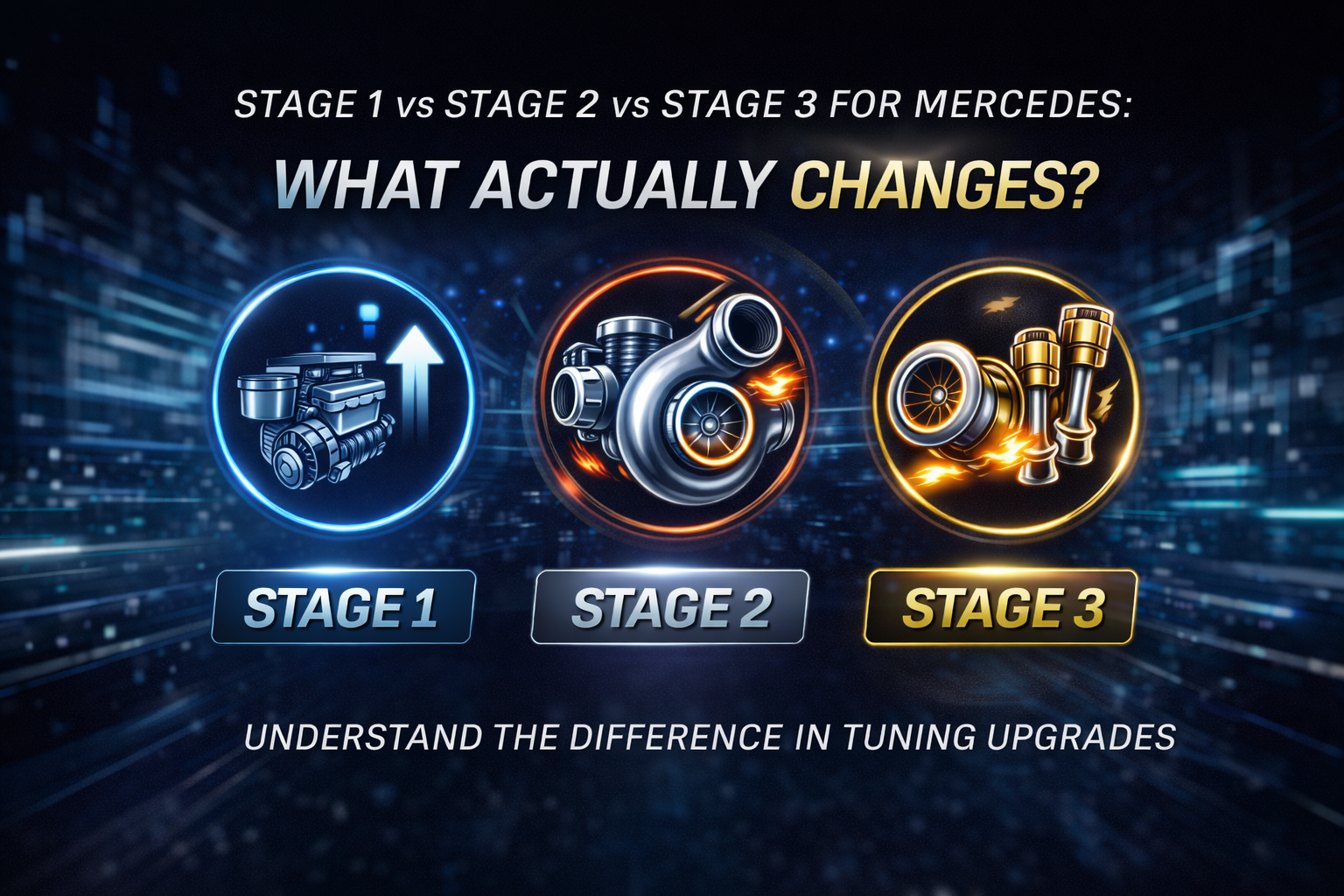
If you’ve ever searched for Mercedes tuning upgrades, you’ve seen it everywhere:
“Stage 1 available.”
“Stage 2 package.”
“Full Stage 3 build.”
But what do these “stages” actually mean?
Is Stage 3 always better?
Does Stage 2 destroy reliability?
And why do two different tuning companies sometimes offer completely different numbers for the same stage?
Let’s break it down — clearly, honestly, and without marketing exaggeration.
First Important Truth: There Is No Universal Definition
Here’s something most people don’t realize:
There is no official Mercedes-Benz definition of Stage 1, Stage 2, or Stage 3.
These are industry terms created by tuners.
That means:
- Stage 1 from Company A ≠ Stage 1 from Company B
- Power gains vary
- Hardware requirements differ
Think of stages as “levels of modification intensity” rather than official categories.
What Is Stage 1 Tuning for Mercedes?
🔹 The Simplest Form of Performance Upgrade
Stage 1 typically means:
- ECU software remap
- No hardware changes
- Factory turbo, exhaust, intercooler remain stock
It’s the most common entry-level upgrade for:
- AMG models (C63, E63, G63)
- Turbocharged Mercedes engines
- Even diesel Mercedes vehicles
How Much Power Does Stage 1 Add?
Typical gains:
- +15–25% horsepower
- +20–30% torque
Example:
A Mercedes-AMG G63 (W463A):
- Stock: ~577 hp
- Stage 1: 650–700 hp
And yes — that’s achieved without opening the engine.
Why Stage 1 Feels So Dramatic
Modern Mercedes engines are “understressed” from factory.
Manufacturers leave a safety margin for:
- emissions regulations
- global fuel quality
- climate differences
- warranty protection
Stage 1 simply unlocks part of that reserved potential.
As one tuner once joked:
“Mercedes sells you 80% of the engine. Stage 1 gives you the other 20%.”
Is Stage 1 Safe?
When done properly:
✔ Yes
When done aggressively:
✖ Not always
Reliability depends on:
- Fuel quality
- Heat management
- Driving style
- Quality of tuning file
What Is Stage 2?
Now things start getting more serious.
Stage 2 usually includes:
- ECU remap
- High-flow downpipes
- Upgraded intake system
- Sometimes upgraded intercooler
The key difference?
Stage 2 requires hardware modifications.
Why Hardware Changes Matter
The biggest restriction in turbocharged engines is airflow.
Stage 2 removes factory bottlenecks:
- Stock catalytic converters are restrictive
- Factory intakes are noise-optimized, not performance-optimized
- Intercoolers may struggle under increased boost
More airflow = more power potential.
Typical Power Gains (AMG Example)
C63 S:
- Stock: 503 hp
- Stage 1: ~580 hp
- Stage 2: 620–650 hp
G63:
- Stage 2 can reach 700–750 hp
But here’s the catch:
Stage 2 increases stress on:
- Turbochargers
- Transmission
- Cooling system
Stage 2 Reality Check
More power = more heat.
More heat = more wear.
If someone tells you Stage 2 has “zero downsides,”
they are selling, not explaining.
What Is Stage 3?
Stage 3 is no longer a software upgrade.
It’s a build.
Typically includes:
- Upgraded turbochargers
- Strengthened fuel system
- Larger intercooler
- Upgraded exhaust system
- Sometimes forged engine internals
Stage 3 is where cars move from “fast street car”
to “serious performance machine.”
Example: AMG GT or G63 Stage 3
You might see numbers like:
- 800–1000+ horsepower
- Massive torque increase
- 0–100 km/h times that rival supercars
But this is no longer factory comfort territory.
Stage 3 cars:
- Require expert maintenance
- Often sacrifice daily drivability
- Increase running costs significantly
The Real Difference Between Stages
| Stage | Software | Hardware Changes | Power Gain | Reliability Impact |
| Stage 1 | Yes | No | Moderate | Minimal (if done well) |
| Stage 2 | Yes | Yes (basic airflow mods) | High | Medium |
| Stage 3 | Yes | Major mechanical upgrades | Extreme | Depends on build quality |
Common Myths About Tuning
❌ “Stage 3 is always better.”
Not if you daily-drive your car.
❌ “Stage 1 is completely risk-free.”
Any performance increase increases stress.
❌ “More boost = more fun.”
More boost = more heat. Heat is the real enemy.
Which Stage Is Right for You?
Daily driver?
Stage 1.
Weekend performance enthusiast?
Stage 2 (with proper cooling).
Want to build a monster?
Stage 3 — but understand the commitment.
Interesting Fact
Most AMG owners who tune stop at Stage 1.
Why?
Because modern Mercedes engines are already extremely powerful.
Stage 1 often gives the best balance of thrill vs reliability.
The Boost Conversation
Many people ask:
“How much boost can my Mercedes handle?”
The answer depends on:
- Engine code
- Turbo type
- Transmission limits
- Cooling system capacity
Boost alone does not define power. Airflow + fuel + ignition timing + cooling all matter.
A Simple Analogy
Think of tuning like fitness training.
Stage 1 = optimized diet and training
Stage 2 = supplements added
Stage 3 = performance athlete program
Each step requires more discipline.
Final Thoughts
Stage 1, Stage 2, and Stage 3 are not just marketing labels.
They represent increasing levels of mechanical commitment.
Before choosing a stage, ask yourself:
- Is this a daily driver?
- Am I prepared for maintenance costs?
- Do I want usable power or peak numbers?
Because sometimes the smartest upgrade is not the biggest one.


Who doesn’t love free stuff? Especially when it’s ‘7m.cn ma cao truc tuyen free’! This site delivers the goods without charging a dime. Awesome! 7m.cn ma cao truc tuyen free.
Need the ‘kết quả 7m ma cao’? I get all my results from this site. It’s my go-to place after every match. Such a great resource! kết quả 7m ma cao.
ss game is getting some buzz so I checked it out. Its okay, nothing ground breaking. If you are looking for ss game, check out the site yourself here: ss game